


Stock Broker
Binary Options
Forex and CFDs
We help resolve the following issues:

Crypto Investments
WE ARE A TEAM OF LAWYERS, ANALYSTS, AND SPECIALISTS IN RECOVERING FUNDS LOST TO FRAUD
🔒 This site uses cookies
Cookie management
Cookies necessary for the site to function properly are always enabled. Other cookies can be configured.


INTRODUCTION
A law firm that helps clients navigate complex financial matters and protect their interests in disputes involving financial services, payment providers, and online platforms.
Over the course of its work, the firm has gone through several key stages of development: from handling its first cases involving disputed transactions and blocked withdrawals to building a well-established practice in financial disputes.
Over time, BWS LEGAL LIMITED has developed an internal standard for working with evidence (payments, statements, correspondence, and service terms), as well as an approach to case handling where speed, legal precision, and consistency are essential.
Particular attention is given to cross-border cases involving multiple jurisdictions, currencies, and payment chains — such matters require a heightened level of discipline in both documentation and communication.
Over the course of its work, the firm has gone through several key stages of development: from handling its first cases involving disputed transactions and blocked withdrawals to building a well-established practice in financial disputes.
Over time, BWS LEGAL LIMITED has developed an internal standard for working with evidence (payments, statements, correspondence, and service terms), as well as an approach to case handling where speed, legal precision, and consistency are essential.
Particular attention is given to cross-border cases involving multiple jurisdictions, currencies, and payment chains — such matters require a heightened level of discipline in both documentation and communication.
BWS LEGAL LIMITED —
WE WORK SYSTEMATICALLY:
We assess the circumstances, collect evidence, build a legal position, and support the client at every stage — from the initial consultation to the outcome of the case
OUR MISSION
To make the process clear and manageable: you understand what is happening, what steps are being taken, and which documents are required.
Communication is conducted transparently, with due regard for confidentiality and legal accuracy.
Communication is conducted transparently, with due regard for confidentiality and legal accuracy.
WE WORK SYSTEMATICALLY:
We assess the circumstances, collect evidence, build a legal position, and support the client at every stage — from the initial consultation to the outcome of the case
OUR MISSION
To make the process clear and manageable: you understand what is happening, what steps are being taken, and which documents are required.
Communication is conducted transparently, with due regard for confidentiality and legal accuracy.
Communication is conducted transparently, with due regard for confidentiality and legal accuracy.

Our work is focused on providing legal assistance and representing the interests of individuals affected by financial fraud and other unlawful actions.
ATTENTION!i b «BWS LEGAL LIMITED» does not provide training in investments, cryptocurrency, or trading, and does not manage clients’ funds.
IN WHAT CASES CLIENTS TURN TO US
EXPERTISE

01
02
02
03
04
STOCK BROKER FRAUD
A company or individual who, under the pretext of generating additional income in the financial markets, has misappropriated your savings.


CRYPTO INVESTMENT FRAUD
Modern fraudsters often resort to this method because they not only steal your funds but also profit from their growth.

FOREX AND CFD FRAUD
Forex and CFD schemes are a common method of misappropriating funds from individuals in Europe and the CIS. Our specialists successfully recover more than 96% of affected funds.

BINARY OPTIONS FRAUD
A widely used method of misappropriating funds is the operation of binary options schemes from which it is impossible to obtain a payout independently.

OUR ADVANTAGES
EXPERTISE
RESPONSIBILITY
We take on a case only when we see a real opportunity to help you.
That is why our success rate exceeds 90% in completed recoveries.
That is why our success rate exceeds 90% in completed recoveries.
MORAL DAMAGES COMPENSATION
In 72% of cases, we help clients obtain compensation for moral damages.
Thanks to our experience and cooperation with various authorities, we achieve positive outcomes.
Thanks to our experience and cooperation with various authorities, we achieve positive outcomes.
AN EXPERIENCED TEAM OF LAWYERS
Our specialists have many years of experience in recovering funds from fraudsters and questionable financial organizations.
WE SIGN AN AGREEMENT
We enter into an agreement with you to protect both parties: on our side, the obligation is to carry out the fund recovery procedure; on your side, the obligation is to pay the agreed amount for the work performed.
NO UPFRONT FEES OR HIDDEN CHARGES
We work on a Result – Payment basis. You pay the company’s fee for the work performed only after the successful recovery of your funds.
SHORT TIMEFRAMES
Initial results within 48–72 hours; the average recovery period is 1–14 days.
*Everything depends on the complexity of the case. We always strive to act as promptly as possible, although in some situations the timeframe may exceed these estimates.
OUR TEAM — CORE MEMBERS
SPECIALISTS
Ciarán is the founder and Managing Partner of the firm. He oversees the areas related to technology, evidence collection and verification, as well as privacy matters.
He has deep expertise in chargeback procedures and disputed transactions, and regularly works with security services and anti-fraud departments of major banks, taking into account that each institution has its own requirements for document formats and internal review procedures.
Leiden University (Netherlands) — LL.M., 2006
KU Leuven (Belgium) — LL.B., 2004
University of Vienna (Austria) — B.A., 2001
He has deep expertise in chargeback procedures and disputed transactions, and regularly works with security services and anti-fraud departments of major banks, taking into account that each institution has its own requirements for document formats and internal review procedures.
- Education
Leiden University (Netherlands) — LL.M., 2006
KU Leuven (Belgium) — LL.B., 2004
University of Vienna (Austria) — B.A., 2001
Company Founder
Cian Doran
Fionn is the co-founder of the firm and a practitioner with many years of experience at the intersection of banking security and online fraud investigations.
He has experience working with the security services of Swedbank, SEB Bank, and Citadele Bank, and understands how internal reviews are conducted, which evidence formats are accepted, and which requirements are critical for the successful handling of a case.
Fionn has been involved in matters related to online fraud, fake investment platforms, and unfair payment schemes.
As part of projects and legal actions, he helped secure the shutdown of 69 companies linked to fraudulent practices and contributed to the recovery of more than EUR 15 million for victims through completed cases and settlements.
University of Amsterdam (Netherlands) — LL.M., 2006
Copenhagen Business School (Denmark) — B.Sc., 2003
He has experience working with the security services of Swedbank, SEB Bank, and Citadele Bank, and understands how internal reviews are conducted, which evidence formats are accepted, and which requirements are critical for the successful handling of a case.
Fionn has been involved in matters related to online fraud, fake investment platforms, and unfair payment schemes.
As part of projects and legal actions, he helped secure the shutdown of 69 companies linked to fraudulent practices and contributed to the recovery of more than EUR 15 million for victims through completed cases and settlements.
- Education
University of Amsterdam (Netherlands) — LL.M., 2006
Copenhagen Business School (Denmark) — B.Sc., 2003
Co-Founder
Fionn O’Rourke
Shauna is the firm’s Chief Lawyer and Head of Corporate Practice. She joined the team in January 2020. She specializes in strategic M&A transactions, private equity matters, and the structuring of venture capital investments, both in the domestic market and in cross-border projects.
She has more than 20 years of practical experience in mergers and acquisitions, LBOs, growth capital, venture financing, and securities law. Her work covers a broad range of matters, including private equity transactions on behalf of funds, as well as strategic corporate projects for companies, such as asset carve-outs, joint ventures, IPO preparation, and market expansion.
Before joining the firm, she worked at international law firms rooted in both French and Anglo-Saxon legal traditions, where she handled cross-border transactions and advised clients across a wide range of industries, from fintech and e-commerce to industrials and technology.
Diplôme de Juriste Conseil d’Entreprise (DJCE) and Diploma in Business Law
Université de Strasbourg, Strasbourg, France, 1998
Specialized coursework in Corporate Law, Financial Transactions, and Cross-Border Mergers & Acquisitions
Master in Law (LL.M.-track) in European and International Business Law
KU Leuven, Leuven, Belgium, 1999
Focus on Corporate Governance, Private Equity Structures, and EU Company Law
Master of Laws (LL.M.) in International Business Law
Leiden University, Leiden, The Netherlands, 2001
Specialized in Mergers & Acquisitions, Securities Regulation, and Cross-Border Transactions
She has more than 20 years of practical experience in mergers and acquisitions, LBOs, growth capital, venture financing, and securities law. Her work covers a broad range of matters, including private equity transactions on behalf of funds, as well as strategic corporate projects for companies, such as asset carve-outs, joint ventures, IPO preparation, and market expansion.
Before joining the firm, she worked at international law firms rooted in both French and Anglo-Saxon legal traditions, where she handled cross-border transactions and advised clients across a wide range of industries, from fintech and e-commerce to industrials and technology.
- Education
Diplôme de Juriste Conseil d’Entreprise (DJCE) and Diploma in Business Law
Université de Strasbourg, Strasbourg, France, 1998
Specialized coursework in Corporate Law, Financial Transactions, and Cross-Border Mergers & Acquisitions
Master in Law (LL.M.-track) in European and International Business Law
KU Leuven, Leuven, Belgium, 1999
Focus on Corporate Governance, Private Equity Structures, and EU Company Law
Master of Laws (LL.M.) in International Business Law
Leiden University, Leiden, The Netherlands, 2001
Specialized in Mergers & Acquisitions, Securities Regulation, and Cross-Border Transactions
Chief Legal Counsel
Shauna van Aardenne
Neila heads the department handling cases against exchange brokers and joined the firm in September 2023. She manages matters involving unfair brokerage practices, pseudo-investment platforms, and disputes with financial intermediaries.
She also assists foreign companies in developing preventive measures, conducting insolvency procedures, and protecting their interests in litigation related to business, the investment market, financial projects, and startups.
A separate focus of her practice is evidence work: preserving correspondence and transaction records, analyzing platform agreements and regulations, and preparing legal positions for banks, payment providers, and regulatory submissions. Neila combines corporate and financial law with insolvency practice, which allows her to build strategies not on a piecemeal basis, but systematically — from risk prevention to recovery and asset restitution.
Neila is also engaged in academic work and delivers lectures on insolvency law and distressed asset management in university programs.
Master’s degree (Master di II livello) in “Company Law”, “Business Law” track
Università di Bologna, Bologna, Italy — 2020/2021
Specialized coursework in Corporate Governance, Financial Regulation, and Cross-Border
Commercial Disputes
University Diploma (Academy) in “Domestic and International Arbitration Law”
University of Vienna, Vienna, Austria — 2020/2021
Focus on Arbitration Procedure, Evidence Strategy, and Enforcement of Arbitral Awards
University Diploma (Executive programme) in “Insolvency Law” (Distressed Companies)
University of Amsterdam, Amsterdam, The Netherlands — 2019/2020
Specialized in Insolvency Proceedings, Restructuring Tools, and Creditor Protection in the EU
She also assists foreign companies in developing preventive measures, conducting insolvency procedures, and protecting their interests in litigation related to business, the investment market, financial projects, and startups.
A separate focus of her practice is evidence work: preserving correspondence and transaction records, analyzing platform agreements and regulations, and preparing legal positions for banks, payment providers, and regulatory submissions. Neila combines corporate and financial law with insolvency practice, which allows her to build strategies not on a piecemeal basis, but systematically — from risk prevention to recovery and asset restitution.
Neila is also engaged in academic work and delivers lectures on insolvency law and distressed asset management in university programs.
- Education
Master’s degree (Master di II livello) in “Company Law”, “Business Law” track
Università di Bologna, Bologna, Italy — 2020/2021
Specialized coursework in Corporate Governance, Financial Regulation, and Cross-Border
Commercial Disputes
University Diploma (Academy) in “Domestic and International Arbitration Law”
University of Vienna, Vienna, Austria — 2020/2021
Focus on Arbitration Procedure, Evidence Strategy, and Enforcement of Arbitral Awards
University Diploma (Executive programme) in “Insolvency Law” (Distressed Companies)
University of Amsterdam, Amsterdam, The Netherlands — 2019/2020
Specialized in Insolvency Proceedings, Restructuring Tools, and Creditor Protection in the EU
Head of the Department for Cases Against Stock Brokers
Neila Kavanagh
Marek leads the firm’s practice in cryptocurrency and digital asset matters and has been with the firm since February 2017.
Before entering legal practice, he held a senior position in the cybersecurity division of Swedish public institutions, where he was responsible for assessing digital risks and responding to complex incidents.
At the firm, Marek advises private and institutional clients on the legal protection of crypto assets, oversees recovery processes, and works with crypto exchanges and international regulators to ensure the transparency and legality of transactions.
He develops protection strategies for clients affected by cyber fraud and crypto scams, conducts compliance audits of crypto platforms for AML/KYC and personal data protection requirements, and advises on digital asset and smart contract transactions — from legal due diligence to the risk assessment of specific blockchain projects.
LL.M. in Financial Law and Digital Assets
University of Groningen, Groningen, The Netherlands — 2016
Thesis: “Legal Regulation of Cryptoassets and Digital Asset Markets in EU and Cross-Border Practice”
Master of Laws (LL.M.) in European and International Law
Stockholm University, Stockholm, Sweden — 2014
Specialization: Financial Markets, Data Protection, and Regulatory Cooperation
Coursework: “Financial Crime & Market Abuse” and “International Enforcement and Cooperation”
Certificate in Anti-Money Laundering (AML) and Compliance (KYC)
International Compliance Association (ICA), EU Program — 2015
Training in risk-based AML frameworks, sanctions screening, and compliance controls for financial and crypto service providers
Course on Legal Aspects of Blockchain and Smart Contracts
KU Leuven (Online Executive Program), Belgium — 2017
Overview of legal frameworks for blockchain use, smart contract risk allocation, and digital transactions
Before entering legal practice, he held a senior position in the cybersecurity division of Swedish public institutions, where he was responsible for assessing digital risks and responding to complex incidents.
At the firm, Marek advises private and institutional clients on the legal protection of crypto assets, oversees recovery processes, and works with crypto exchanges and international regulators to ensure the transparency and legality of transactions.
He develops protection strategies for clients affected by cyber fraud and crypto scams, conducts compliance audits of crypto platforms for AML/KYC and personal data protection requirements, and advises on digital asset and smart contract transactions — from legal due diligence to the risk assessment of specific blockchain projects.
- Education
LL.M. in Financial Law and Digital Assets
University of Groningen, Groningen, The Netherlands — 2016
Thesis: “Legal Regulation of Cryptoassets and Digital Asset Markets in EU and Cross-Border Practice”
Master of Laws (LL.M.) in European and International Law
Stockholm University, Stockholm, Sweden — 2014
Specialization: Financial Markets, Data Protection, and Regulatory Cooperation
Coursework: “Financial Crime & Market Abuse” and “International Enforcement and Cooperation”
Certificate in Anti-Money Laundering (AML) and Compliance (KYC)
International Compliance Association (ICA), EU Program — 2015
Training in risk-based AML frameworks, sanctions screening, and compliance controls for financial and crypto service providers
Course on Legal Aspects of Blockchain and Smart Contracts
KU Leuven (Online Executive Program), Belgium — 2017
Overview of legal frameworks for blockchain use, smart contract risk allocation, and digital transactions
Head of the Cryptocurrency Cases Department
Marek Šimek
Declan heads the practice focused on Forex and CFD fraud cases. He specializes in the legal protection of victims, the identification of fraudulent schemes, the recovery of misappropriated funds, and the development of strategies to counter unlawful conduct in the online trading market.
In his work, Declan combines a procedural approach with a strong understanding of the regulatory environment: he analyzes the “broker’s” business model, terms of service, payment history, and communications, prepares the evidentiary framework, and develops legal positions for interaction with payment providers, banks, and relevant authorities.
He helps clients navigate complex cases in a systematic way — from the initial risk assessment to properly prepared legal submissions and support throughout the recovery process.
LL.M. in Financial Law and Securities Regulation
University of Vienna, Vienna, Austria — 2013
Thesis: “Legal Mechanisms for Fraud Prevention in Retail Trading: Forex and CFD Markets in the EU”
LL.B. in European and International Law
University of Barcelona, Barcelona, Spain — 2011
Specialization: Financial Markets, Consumer Protection, and Cross-Border Dispute Resolution
Coursework: “Fraud in Financial Markets” and “Regulation of Retail Derivatives (CFDs)”
Certificate in Anti-Money Laundering (AML) and Compliance (KYC)
Frankfurt School of Finance & Management (Executive Education), Frankfurt, Germany — 2014
Training in risk-based AML frameworks, sanctions screening, and compliance controls for financial and payment service providers
Professional Training in Financial Fraud Detection and Prevention
European Banking Institute (EBI), Frankfurt, Germany — 2015
Program on fraud typologies, forensic documentation, and prevention strategies in financial services
In his work, Declan combines a procedural approach with a strong understanding of the regulatory environment: he analyzes the “broker’s” business model, terms of service, payment history, and communications, prepares the evidentiary framework, and develops legal positions for interaction with payment providers, banks, and relevant authorities.
He helps clients navigate complex cases in a systematic way — from the initial risk assessment to properly prepared legal submissions and support throughout the recovery process.
- Education
LL.M. in Financial Law and Securities Regulation
University of Vienna, Vienna, Austria — 2013
Thesis: “Legal Mechanisms for Fraud Prevention in Retail Trading: Forex and CFD Markets in the EU”
LL.B. in European and International Law
University of Barcelona, Barcelona, Spain — 2011
Specialization: Financial Markets, Consumer Protection, and Cross-Border Dispute Resolution
Coursework: “Fraud in Financial Markets” and “Regulation of Retail Derivatives (CFDs)”
Certificate in Anti-Money Laundering (AML) and Compliance (KYC)
Frankfurt School of Finance & Management (Executive Education), Frankfurt, Germany — 2014
Training in risk-based AML frameworks, sanctions screening, and compliance controls for financial and payment service providers
Professional Training in Financial Fraud Detection and Prevention
European Banking Institute (EBI), Frankfurt, Germany — 2015
Program on fraud typologies, forensic documentation, and prevention strategies in financial services
Head of the Forex and CFD Fraud Department
Declan Byrne
Aoife is the Chief Financial Analyst with more than 13 years of experience in financial market analysis and the investigation of fraudulent operations.
She works on preparing the evidentiary foundation that helps legal teams secure the recovery of client funds lost in Forex, CFD, binary options, and cryptocurrency markets.
Aoife works at the intersection of financial analytics and compliance. She is highly familiar with AML/KYC standards, understands the logic of payment chains, and recognizes the typical patterns of fraudulent schemes, including fake fees, pseudo-taxes, multi-layered transfers, substitution of payment details, and circular transactions.
MSc in Finance and Risk Management
Stockholm School of Economics, Stockholm, Sweden
Specialization: Financial Risk Management and Fraud Prevention
Thesis: “Identification of Fraud Schemes in Retail Financial Markets”
Bachelor’s Degree in Economics and Finance
University of Amsterdam, Amsterdam, The Netherlands
Key Courses: Financial Markets, Compliance & Financial Crime Prevention, Applied Data Analysis
Certificate in Anti-Money Laundering (AML) and Know Your Customer (KYC)
International Compliance Association (ICA), EU Program
Comprehensive certification program in anti-money laundering, sanctions screening, and client verification controls
Course in Financial Crime Investigation and Transaction Analysis
Frankfurt School of Finance & Management (Executive Education), Frankfurt, Germany
Specialized course focused on transaction analysis, evidence documentation, and fraud typologies in financial services
She works on preparing the evidentiary foundation that helps legal teams secure the recovery of client funds lost in Forex, CFD, binary options, and cryptocurrency markets.
Aoife works at the intersection of financial analytics and compliance. She is highly familiar with AML/KYC standards, understands the logic of payment chains, and recognizes the typical patterns of fraudulent schemes, including fake fees, pseudo-taxes, multi-layered transfers, substitution of payment details, and circular transactions.
- Education
MSc in Finance and Risk Management
Stockholm School of Economics, Stockholm, Sweden
Specialization: Financial Risk Management and Fraud Prevention
Thesis: “Identification of Fraud Schemes in Retail Financial Markets”
Bachelor’s Degree in Economics and Finance
University of Amsterdam, Amsterdam, The Netherlands
Key Courses: Financial Markets, Compliance & Financial Crime Prevention, Applied Data Analysis
Certificate in Anti-Money Laundering (AML) and Know Your Customer (KYC)
International Compliance Association (ICA), EU Program
Comprehensive certification program in anti-money laundering, sanctions screening, and client verification controls
Course in Financial Crime Investigation and Transaction Analysis
Frankfurt School of Finance & Management (Executive Education), Frankfurt, Germany
Specialized course focused on transaction analysis, evidence documentation, and fraud typologies in financial services
Chief Financial Analyst
Aoife Rosenberg
Ronan is a leading cybersecurity expert with more than 8 years of experience in countering cyber threats and protecting data. He specializes in security within the financial sector, including the protection of digital assets, confidential client information, and the investigation of incidents involving fraud in financial markets, Forex, CFD, and cryptocurrency platforms.
Ronan began his professional career in public institutions, where he worked on high-complexity incidents and contributed to the development of cyber defense practices. He later held a senior role in the cyber division of Swedish special services, where he participated in developing approaches to risk assessment, attack response, and security architecture.
Today, he applies these practices in client work by conducting comprehensive cyber investigations, helping preserve digital evidence, and building protection strategies that take into account both the technical and legal aspects of each case.
MSc in Cyber Security
Aalto University, Espoo/Helsinki, Finland
Specialization: Advanced Cybersecurity, Incident Response, and Digital Forensics
Bachelor’s Degree in Computer Science
Technical University of Munich (TUM), Munich, Germany
Key Courses: Network Security, Cryptography, Secure Systems Engineering, and Data Privacy
Certified Information Systems Security Professional (CISSP)
(ISC)² — International Information System Security Certification Consortium
Certification in information security governance, risk management, security architecture, and incident handling
Advanced Training in Blockchain Security and Forensics
University of Tartu, Tartu, Estonia
Focused on blockchain infrastructure, cryptocurrency security, threat modeling, and digital forensic methods
Ronan began his professional career in public institutions, where he worked on high-complexity incidents and contributed to the development of cyber defense practices. He later held a senior role in the cyber division of Swedish special services, where he participated in developing approaches to risk assessment, attack response, and security architecture.
Today, he applies these practices in client work by conducting comprehensive cyber investigations, helping preserve digital evidence, and building protection strategies that take into account both the technical and legal aspects of each case.
- Education
MSc in Cyber Security
Aalto University, Espoo/Helsinki, Finland
Specialization: Advanced Cybersecurity, Incident Response, and Digital Forensics
Bachelor’s Degree in Computer Science
Technical University of Munich (TUM), Munich, Germany
Key Courses: Network Security, Cryptography, Secure Systems Engineering, and Data Privacy
Certified Information Systems Security Professional (CISSP)
(ISC)² — International Information System Security Certification Consortium
Certification in information security governance, risk management, security architecture, and incident handling
Advanced Training in Blockchain Security and Forensics
University of Tartu, Tartu, Estonia
Focused on blockchain infrastructure, cryptocurrency security, threat modeling, and digital forensic methods
Lead Cybersecurity Expert
Ronan Nyström


OVER THE COURSE OF THE SPECIAL DEPARTMENT’S WORK, OUR TEAM HAS ACHIEVED THE FOLLOWING RESULTS


OVER THE COURSE OF THE SPECIAL DEPARTMENT’S WORK, OUR TEAM HAS ACHIEVED THE FOLLOWING RESULTS

Result
CLIENT TESTIMONIALS ABOUT OUR WORK

Result
CLIENT TESTIMONIALS ABOUT OUR WORK
4.9/5
Anna, like many others, wanted not only to preserve her savings but also to grow them wisely. One day, she came across an advertisement for an “investment platform” that presented itself as a licensed broker and promised stable returns without risk. She was confidently told that an initial deposit of €2,650 could be “grown” to €9,050 in just 2–3 months if she followed the recommendations of a personal analyst.
At first, everything appeared credible: the manager communicated politely and confidently, sent “reports,” showed growth charts, and insisted that market conditions were ideal. Anna could see her “balance” increasing in her personal account, and she was even given one small test withdrawal to strengthen her trust. After that, she was encouraged to top up the account again, under the pretext of “strengthening the position” and taking advantage of a “window of opportunity.”
Anna believed that she had genuinely found a working solution and followed the instructions, expecting to withdraw her profit in the near future.
However, the moment she submitted a request to withdraw the main amount, problems began.
At first, the manager responded evasively and asked her to “wait for confirmation.” Then new conditions began to appear: a “security verification,” an “insurance contribution,” an “international transfer fee,” and even a “tax payment” to unlock the withdrawal. Each time, she was promised that this would be the final step and that the funds would be credited to her card immediately afterwards.
In the end, her requests remained pending, deadlines kept being postponed, and the manager became increasingly unresponsive. Customer support replied with template messages and demanded additional payments, threatening an “account freeze” if she refused.
Realizing that she had been deceived, Anna experienced severe stress. These funds were her personal savings, which she had set aside for important family plans and a long-awaited purchase. She tried to resolve the matter on her own by contacting support, collecting correspondence, and taking screenshots, but all she received were new demands and continued pressure. That was when Anna began looking for real legal assistance and found our organization.
We immediately took on her case. The procedure proved to be complex: the fraudsters operated through a chain of intermediaries, used substitute payment details, and split the payments in order to make tracing more difficult.
Our team analyzed the situation, reconstructed the sequence of transactions, collected the evidence base (correspondence, transfer confirmations, platform data, and the “service” terms), and then developed a legal strategy.
We initiated the necessary claims and formal actions, communicated with financial institutions and relevant authorities, and worked to ensure that the facts of deception and unlawful retention of funds were properly documented. At the same time, we monitored the process and kept Anna informed at every stage so that she clearly understood what was happening and what actions were being taken.
After 1.5 months of systematic work, we achieved a result: we managed to recover not only Anna’s initial €2,650, but also secure compensation for part of the expenses and fees incurred as a result of the fraudsters’ pressure and the prolonged withholding of funds. The total recovered amount came to €6,745.
Anna sincerely thanked us for the work carried out and admitted that this case had become a serious lesson for her. She specifically noted that she would not have been able to deal with such a scheme on her own or bring the matter to a result, because the fraudsters were deliberately complicating the process and trying to pressure her into paying again and again.
At first, everything appeared credible: the manager communicated politely and confidently, sent “reports,” showed growth charts, and insisted that market conditions were ideal. Anna could see her “balance” increasing in her personal account, and she was even given one small test withdrawal to strengthen her trust. After that, she was encouraged to top up the account again, under the pretext of “strengthening the position” and taking advantage of a “window of opportunity.”
Anna believed that she had genuinely found a working solution and followed the instructions, expecting to withdraw her profit in the near future.
However, the moment she submitted a request to withdraw the main amount, problems began.
At first, the manager responded evasively and asked her to “wait for confirmation.” Then new conditions began to appear: a “security verification,” an “insurance contribution,” an “international transfer fee,” and even a “tax payment” to unlock the withdrawal. Each time, she was promised that this would be the final step and that the funds would be credited to her card immediately afterwards.
In the end, her requests remained pending, deadlines kept being postponed, and the manager became increasingly unresponsive. Customer support replied with template messages and demanded additional payments, threatening an “account freeze” if she refused.
Realizing that she had been deceived, Anna experienced severe stress. These funds were her personal savings, which she had set aside for important family plans and a long-awaited purchase. She tried to resolve the matter on her own by contacting support, collecting correspondence, and taking screenshots, but all she received were new demands and continued pressure. That was when Anna began looking for real legal assistance and found our organization.
We immediately took on her case. The procedure proved to be complex: the fraudsters operated through a chain of intermediaries, used substitute payment details, and split the payments in order to make tracing more difficult.
Our team analyzed the situation, reconstructed the sequence of transactions, collected the evidence base (correspondence, transfer confirmations, platform data, and the “service” terms), and then developed a legal strategy.
We initiated the necessary claims and formal actions, communicated with financial institutions and relevant authorities, and worked to ensure that the facts of deception and unlawful retention of funds were properly documented. At the same time, we monitored the process and kept Anna informed at every stage so that she clearly understood what was happening and what actions were being taken.
After 1.5 months of systematic work, we achieved a result: we managed to recover not only Anna’s initial €2,650, but also secure compensation for part of the expenses and fees incurred as a result of the fraudsters’ pressure and the prolonged withholding of funds. The total recovered amount came to €6,745.
Anna sincerely thanked us for the work carried out and admitted that this case had become a serious lesson for her. She specifically noted that she would not have been able to deal with such a scheme on her own or bring the matter to a result, because the fraudsters were deliberately complicating the process and trying to pressure her into paying again and again.
RECOVERY OF €6,745 FROM A FRAUDULENT BROKER
Anna
5/5
Alisa from Germany had long been looking for a way to grow her savings and decided to try crypto investments. Online, she came across a platform that promised rapid capital growth and guidance from experienced analysts.
The website looked convincing: clean design, “partner logos,” supposed licenses, and customer reviews. After her first conversation with a “personal consultant,” Alisa felt reassured and decided to start with a small amount simply to test how the service worked in practice.
She initially deposited €500 to evaluate the platform without risking a large sum.
A few days later, the consultant showed her that the deposit was growing actively: her personal account displayed profits, reports on “trades” appeared, and the manager confidently explained that the growth was the result of a “correct strategy” and “favorable market conditions.”
Encouraged by the first figures and believing that everything looked transparent, Alisa made several additional deposits following the consultant’s recommendations and under the pretext of “strengthening the position.” In the end, the total amount of her transfers reached €9,800.
When the balance on the platform approached €18,000, Alisa decided to withdraw at least part of the funds in order to confirm that the service actually paid out and to avoid risking the entire amount. However, instead of receiving a payout, she was told that she first needed to pay a “verification fee” of €300. Alisa refused, as she found this suspicious. More demands followed: a “tax deposit,” “transaction review costs,” a “wallet confirmation fee,” and other fabricated payments. Each time, she was told that this was the “final step,” and that only after making the payment would she receive her money.
Only then did Alisa realize that she was dealing with fraudsters. She tried to obtain clear answers, requested documents and withdrawal terms, but instead of transparency she faced pressure and template responses.
Some of her withdrawal requests were simply ignored, and later support became increasingly unresponsive. Realizing that the situation was dragging on and that any further payment would only increase her losses, Alisa began looking for real help and turned to our law firm.
During the initial consultation, we assessed her situation and confirmed that recovery was possible. We requested proof of transfers, correspondence with the “consultant,” recipient details, and transaction history.
After that, our specialists analyzed the transactions, prepared submissions to the bank and the payment intermediary, and initiated the recovery procedure in accordance with the applicable rules.
At the same time, we documented the signs of deception and the imposition of additional payments as a condition for withdrawal, which is one of the key indicators of a fraudulent scheme.
After 14 days, the full amount — €9,800 — was successfully returned to Alisa’s account. She admitted that this experience became a serious lesson for her, and that she is now far more cautious about online investments, especially when they involve “guaranteed returns” and demands for additional fees before withdrawal.
If you have found yourself in a similar situation, remember that we are ready to help you recover your funds and restore justice. Submit a request for a free consultation and begin the recovery process today.
The website looked convincing: clean design, “partner logos,” supposed licenses, and customer reviews. After her first conversation with a “personal consultant,” Alisa felt reassured and decided to start with a small amount simply to test how the service worked in practice.
She initially deposited €500 to evaluate the platform without risking a large sum.
A few days later, the consultant showed her that the deposit was growing actively: her personal account displayed profits, reports on “trades” appeared, and the manager confidently explained that the growth was the result of a “correct strategy” and “favorable market conditions.”
Encouraged by the first figures and believing that everything looked transparent, Alisa made several additional deposits following the consultant’s recommendations and under the pretext of “strengthening the position.” In the end, the total amount of her transfers reached €9,800.
When the balance on the platform approached €18,000, Alisa decided to withdraw at least part of the funds in order to confirm that the service actually paid out and to avoid risking the entire amount. However, instead of receiving a payout, she was told that she first needed to pay a “verification fee” of €300. Alisa refused, as she found this suspicious. More demands followed: a “tax deposit,” “transaction review costs,” a “wallet confirmation fee,” and other fabricated payments. Each time, she was told that this was the “final step,” and that only after making the payment would she receive her money.
Only then did Alisa realize that she was dealing with fraudsters. She tried to obtain clear answers, requested documents and withdrawal terms, but instead of transparency she faced pressure and template responses.
Some of her withdrawal requests were simply ignored, and later support became increasingly unresponsive. Realizing that the situation was dragging on and that any further payment would only increase her losses, Alisa began looking for real help and turned to our law firm.
During the initial consultation, we assessed her situation and confirmed that recovery was possible. We requested proof of transfers, correspondence with the “consultant,” recipient details, and transaction history.
After that, our specialists analyzed the transactions, prepared submissions to the bank and the payment intermediary, and initiated the recovery procedure in accordance with the applicable rules.
At the same time, we documented the signs of deception and the imposition of additional payments as a condition for withdrawal, which is one of the key indicators of a fraudulent scheme.
After 14 days, the full amount — €9,800 — was successfully returned to Alisa’s account. She admitted that this experience became a serious lesson for her, and that she is now far more cautious about online investments, especially when they involve “guaranteed returns” and demands for additional fees before withdrawal.
If you have found yourself in a similar situation, remember that we are ready to help you recover your funds and restore justice. Submit a request for a free consultation and begin the recovery process today.
LOST €9,800 IN CRYPTO INVESTMENTS
Alisa
4.8/5
Sofia from Belgium had long been looking for a clear and “safe” way to generate additional income and decided to try CFD trading. It seemed to her to be a modern instrument: fast, convenient, and offering the ability to control trades.
In online advertising, she came across a platform that promised “minimal risks,” training for beginners, and support from a personal analyst. During the first call, the “consultant” spoke confidently, explained everything in simple terms, and assured her that they operated “according to European standards.” Sofia felt reassured and decided to start with a small amount in order to test the service and understand how it worked.
She deposited €250 and received access to a personal account, where the balance began to “grow” almost immediately. The analyst stayed in regular contact, sent messages with recommendations, showed charts, and insisted that it was a “favorable market” and that she should increase the deposit so as “not to miss the opportunity.” Over the following days, Sofia deposited another €700, then €1,500, then €2,500, and later an additional €4,000, gradually bringing the total amount transferred to €8,950.
After some time, the account displayed approximately €19,000, and Sofia decided to withdraw at least part of the profit to confirm that the platform actually paid out. Instead, she was told that the withdrawal would only be possible after paying a “liquidity processing fee” and providing “confirmation of the source of funds.” Sofia became suspicious and refused to make any additional payments. After that, her withdrawal request was rejected, and further attempts were blocked under the pretext of a “regulatory review” and an “internal audit.”
The analyst became less responsive, while customer support limited itself to template messages and demands for new “fees,” promising that this was “the final step.”
Only then did Sofia fully realize that she was dealing with fraudsters. She felt confused and angry with herself for having trusted them, because this money was a significant amount for her and had been set aside for personal plans. Not knowing what to do next, she began looking for real assistance and turned to our law firm.
During the initial consultation, we explained that cases of this kind are often recoverable, especially when payments were made through identifiable financial channels and there is supporting evidence in the form of transfer confirmations, correspondence, and the relevant “service” terms.
We immediately began work: we analyzed all payments, collected the evidence base, prepared submissions to financial institutions, and sent requests to the receiving bank and along the transaction chain.
At the same time, we documented the pressure tactics used by the “platform” and its demands for additional fees as a condition for withdrawal, which is a typical sign of fraud.
After 12 days of consistent work, the full amount — €8,950 — was returned to Sofia’s account. She admitted that after this experience she became far more cautious, stopped trusting bold promises made in advertisements, and now always checks any investment project and company documentation before transferring funds.
In online advertising, she came across a platform that promised “minimal risks,” training for beginners, and support from a personal analyst. During the first call, the “consultant” spoke confidently, explained everything in simple terms, and assured her that they operated “according to European standards.” Sofia felt reassured and decided to start with a small amount in order to test the service and understand how it worked.
She deposited €250 and received access to a personal account, where the balance began to “grow” almost immediately. The analyst stayed in regular contact, sent messages with recommendations, showed charts, and insisted that it was a “favorable market” and that she should increase the deposit so as “not to miss the opportunity.” Over the following days, Sofia deposited another €700, then €1,500, then €2,500, and later an additional €4,000, gradually bringing the total amount transferred to €8,950.
After some time, the account displayed approximately €19,000, and Sofia decided to withdraw at least part of the profit to confirm that the platform actually paid out. Instead, she was told that the withdrawal would only be possible after paying a “liquidity processing fee” and providing “confirmation of the source of funds.” Sofia became suspicious and refused to make any additional payments. After that, her withdrawal request was rejected, and further attempts were blocked under the pretext of a “regulatory review” and an “internal audit.”
The analyst became less responsive, while customer support limited itself to template messages and demands for new “fees,” promising that this was “the final step.”
Only then did Sofia fully realize that she was dealing with fraudsters. She felt confused and angry with herself for having trusted them, because this money was a significant amount for her and had been set aside for personal plans. Not knowing what to do next, she began looking for real assistance and turned to our law firm.
During the initial consultation, we explained that cases of this kind are often recoverable, especially when payments were made through identifiable financial channels and there is supporting evidence in the form of transfer confirmations, correspondence, and the relevant “service” terms.
We immediately began work: we analyzed all payments, collected the evidence base, prepared submissions to financial institutions, and sent requests to the receiving bank and along the transaction chain.
At the same time, we documented the pressure tactics used by the “platform” and its demands for additional fees as a condition for withdrawal, which is a typical sign of fraud.
After 12 days of consistent work, the full amount — €8,950 — was returned to Sofia’s account. She admitted that after this experience she became far more cautious, stopped trusting bold promises made in advertisements, and now always checks any investment project and company documentation before transferring funds.
€8,950 LOST ON A CFD PLATFORM
Sofia
4.7/5
Luka from Spain had long been interested in new technologies and the crypto market, followed trends, and regularly read news about blockchain startups. At some point, he decided to invest in a project that was being actively promoted as a “revolutionary investment opportunity,” allegedly featuring unique technology and an upcoming listing on major exchanges.
The first conversations with the “development manager” seemed convincing: Luka was told about a “team of developers,” shown a presentation, promised early access to tokens at a favorable price, and assured that the project had already attracted major investors. Luka felt this could be an opportunity to enter early and make a profit, so he decided to proceed cautiously and see how everything worked in practice.
He made an initial payment of €650 to test the project. The payment was made via bank transfer through a payment provider, so we handled the matter through recovery procedures involving financial channels. He was then given access to a personal account and an “investment dashboard,” where balance growth and “bonus” accruals began appearing almost immediately.
A few days later, the manager began actively pressuring him to increase his investment, arguing that “this was the final pre-sale stage” and that the token price would rise soon. Luka added another €1,200, then €2,500, later €4,000, and after another conversation, an additional €6,300, bringing the total amount transferred to €14,650. When the “balance” displayed more than €28,000, Luka decided to withdraw at least part of the funds to verify that the project was genuinely honoring its commitments.
However, instead of receiving the withdrawal, he was informed that he first had to pay a “withdrawal unlock fee” and a “transaction confirmation fee” before any payout could be processed. Luka became suspicious and refused to send any additional money, as such demands appeared highly questionable.
After that, messages in the chat went unanswered, and his access to the account was later blocked under the pretext of a “security review” and “violation of withdrawal rules.” Luka realized that he had become the victim of a fraudulent scheme.
The situation was especially troubling because the project looked “high-tech” and created the impression of being a real company. Not knowing how to proceed, he began looking for legal assistance and turned to us.
We promptly took the case on. First, we thoroughly examined the circumstances: we collected correspondence with the “startup’s” representatives, transfer confirmations, recipient details, and payment-chain data, and also documented the imposed additional payment demands as a condition for return.
We then analyzed the flow of funds, sent inquiries to the payment provider, and prepared legal claims addressed to the companies and services through which the transactions had passed.
At the same time, we established a structured communication process regarding the recovery procedure in order to strengthen the position and secure the evidentiary basis for the financial institutions involved.
After 19 days of systematic work, the full amount — €14,650 — was returned to Luka’s account. He admitted that this experience fundamentally changed his attitude toward investments: he now reviews projects, legal details, and actual proof of a company’s operations far more carefully before sending money, and he understands how important it is to seek professional assistance in time.
The first conversations with the “development manager” seemed convincing: Luka was told about a “team of developers,” shown a presentation, promised early access to tokens at a favorable price, and assured that the project had already attracted major investors. Luka felt this could be an opportunity to enter early and make a profit, so he decided to proceed cautiously and see how everything worked in practice.
He made an initial payment of €650 to test the project. The payment was made via bank transfer through a payment provider, so we handled the matter through recovery procedures involving financial channels. He was then given access to a personal account and an “investment dashboard,” where balance growth and “bonus” accruals began appearing almost immediately.
A few days later, the manager began actively pressuring him to increase his investment, arguing that “this was the final pre-sale stage” and that the token price would rise soon. Luka added another €1,200, then €2,500, later €4,000, and after another conversation, an additional €6,300, bringing the total amount transferred to €14,650. When the “balance” displayed more than €28,000, Luka decided to withdraw at least part of the funds to verify that the project was genuinely honoring its commitments.
However, instead of receiving the withdrawal, he was informed that he first had to pay a “withdrawal unlock fee” and a “transaction confirmation fee” before any payout could be processed. Luka became suspicious and refused to send any additional money, as such demands appeared highly questionable.
After that, messages in the chat went unanswered, and his access to the account was later blocked under the pretext of a “security review” and “violation of withdrawal rules.” Luka realized that he had become the victim of a fraudulent scheme.
The situation was especially troubling because the project looked “high-tech” and created the impression of being a real company. Not knowing how to proceed, he began looking for legal assistance and turned to us.
We promptly took the case on. First, we thoroughly examined the circumstances: we collected correspondence with the “startup’s” representatives, transfer confirmations, recipient details, and payment-chain data, and also documented the imposed additional payment demands as a condition for return.
We then analyzed the flow of funds, sent inquiries to the payment provider, and prepared legal claims addressed to the companies and services through which the transactions had passed.
At the same time, we established a structured communication process regarding the recovery procedure in order to strengthen the position and secure the evidentiary basis for the financial institutions involved.
After 19 days of systematic work, the full amount — €14,650 — was returned to Luka’s account. He admitted that this experience fundamentally changed his attitude toward investments: he now reviews projects, legal details, and actual proof of a company’s operations far more carefully before sending money, and he understands how important it is to seek professional assistance in time.
RECOVERED €14,650 LOST IN A FAKE CRYPTO STARTUP
Luka
5/5
Leila decided to try increasing her income through investments and turned to a brokerage company that was being actively advertised online. A company representative contacted her promptly, confidently described how easy it would be to make profits, and offered “full support” in managing trades, promising that for a beginner it would be as simple and safe as possible.
At first, everything truly looked convincing.
Leila deposited an initial amount to start using the platform. Her “personal broker” remained in constant contact, explained the basic steps, showed her trades, and demonstrated the growth of funds in her account.
He assured her that the market was “on her side” and that by increasing her deposit she would gain access to more favorable terms, receive “signals,” and accelerate the result. Confident in the company’s reliability and seeing the numbers in her account rise, Leila began increasing her investments. She transferred funds in several payments, and the total amount sent to the account specified by the broker ultimately reached €10,750.
However, as soon as Leila decided to withdraw at least part of the funds, difficulties began. First, she was told that in order to withdraw funds she needed to “activate the payment gateway” and pay an additional amount supposedly to cover a fee. Then the broker began insisting on an “account level upgrade,” explaining that without it withdrawal was impossible due to alleged limit restrictions. Leila sensed that something was wrong and began asking specific questions: why the fee could not be deducted from the balance, why the terms were changing after the funds had already been deposited, and where the requirements for additional payments were actually stated.
In response, the broker began avoiding direct explanations, replying in vague generalities, and then became increasingly unresponsive. Before long, support started sending template messages, and her access to the account was blocked under the pretext of a “security review.”
Left without funds and without any real way to contact the platform’s representatives, Leila turned to our legal organization. During the initial consultation, we carefully reviewed her situation, gathered the key details, and explained that such schemes are a typical sign of fraud, where withdrawals are blocked and new payments are demanded.
We assured her that we would be able to help and immediately began work. Our team promptly analyzed the transfers, collected evidence (payment confirmations, correspondence, terms, and recipient details), prepared submissions to financial institutions, and drafted legal claims along the chain of companies and services through which the transactions had passed.
After 14 days of systematic work, the entire lost amount was returned to Leila’s account. She was deeply grateful for the professionalism and support of our team, noting that she had not expected such a fast result and did not believe that the funds could be recovered in full.
Leila shared her story to warn others about similar situations and to remind them that help is available. In Leila’s words: “I advise people not to delay and to seek a consultation immediately if they see demands for additional payments.”
At first, everything truly looked convincing.
Leila deposited an initial amount to start using the platform. Her “personal broker” remained in constant contact, explained the basic steps, showed her trades, and demonstrated the growth of funds in her account.
He assured her that the market was “on her side” and that by increasing her deposit she would gain access to more favorable terms, receive “signals,” and accelerate the result. Confident in the company’s reliability and seeing the numbers in her account rise, Leila began increasing her investments. She transferred funds in several payments, and the total amount sent to the account specified by the broker ultimately reached €10,750.
However, as soon as Leila decided to withdraw at least part of the funds, difficulties began. First, she was told that in order to withdraw funds she needed to “activate the payment gateway” and pay an additional amount supposedly to cover a fee. Then the broker began insisting on an “account level upgrade,” explaining that without it withdrawal was impossible due to alleged limit restrictions. Leila sensed that something was wrong and began asking specific questions: why the fee could not be deducted from the balance, why the terms were changing after the funds had already been deposited, and where the requirements for additional payments were actually stated.
In response, the broker began avoiding direct explanations, replying in vague generalities, and then became increasingly unresponsive. Before long, support started sending template messages, and her access to the account was blocked under the pretext of a “security review.”
Left without funds and without any real way to contact the platform’s representatives, Leila turned to our legal organization. During the initial consultation, we carefully reviewed her situation, gathered the key details, and explained that such schemes are a typical sign of fraud, where withdrawals are blocked and new payments are demanded.
We assured her that we would be able to help and immediately began work. Our team promptly analyzed the transfers, collected evidence (payment confirmations, correspondence, terms, and recipient details), prepared submissions to financial institutions, and drafted legal claims along the chain of companies and services through which the transactions had passed.
After 14 days of systematic work, the entire lost amount was returned to Leila’s account. She was deeply grateful for the professionalism and support of our team, noting that she had not expected such a fast result and did not believe that the funds could be recovered in full.
Leila shared her story to warn others about similar situations and to remind them that help is available. In Leila’s words: “I advise people not to delay and to seek a consultation immediately if they see demands for additional payments.”
RECOVERY OF €10,750 FROM A FRAUDULENT BROKER
Leila
4.9/5
Daria had always been interested in investments and had long wanted to try her hand at the stock market and index-based instruments. While searching for a suitable platform, she came across an advertisement for a broker offering “favorable conditions,” promising stable returns, and claiming that beginners would be supported by a dedicated team of specialists.
The promises of professional guidance, training, and “careful сопровождение” sounded highly convincing, so Daria decided to start with a modest amount to test the service and understand how everything worked.
At first, everything действительно seemed to be going smoothly. Her personal manager stayed in constant contact, explained the basic steps, suggested “suitable stocks,” and showed performance charts in her account that looked impressive.
Daria regularly received “market analysis” in their correspondence, along with explanations about “entry points,” and was repeatedly told that it was the perfect time to increase her deposit because “the market is offering a real opportunity to profit.” Encouraged by these apparent results and seeing the figures on the platform rise, Daria began increasing her investment. She funded the account through several payments, and the total amount she transferred eventually reached €18,450.
However, as soon as Daria decided to withdraw part of her funds, problems began. First, she was told that a “cross-border processing fee” had to be paid before any withdrawal could be completed. Then came a supposed “profit tax,” followed by yet another demand: “client status verification” through an additional payment allegedly required to activate the withdrawal. Daria tried to clarify why these amounts could not simply be deducted from her balance and where such conditions had been stated in advance, but the responses remained vague and evasive.
Although she complied with part of the requested steps, the funds never arrived. Eventually, her manager began replying less and less frequently and then stopped responding altogether. Shortly afterward, access to Daria’s account was blocked under the pretext of a “security review” and an “internal audit.”
Disappointed and confused, Daria began looking for ways to recover her funds. She researched similar cases, read recommendations, and realized that delays only worked in favor of the fraudsters. On the advice of people who had already been through similar situations, she learned about our legal organization and decided to seek help.
During the initial consultation, we carefully reviewed her case, requested proof of transfers and correspondence, and explained which actions should be avoided in order not to weaken her position. We confirmed that recovery was possible, and once the agreement was signed, our team immediately began work.
We analyzed the payments and recipients, collected the evidentiary materials, prepared submissions to financial institutions, and formulated legal claims addressed to the companies and services through which the transactions had passed. In handling the matter, we used our established methods of working with payment systems and financial institutions in order to challenge the broker’s unlawful conduct and document the clear signs of deception.
Within 16 days, we succeeded in returning the full amount of €18,450 to Daria’s account. She was deeply grateful for the professionalism and speed of our team, which helped her not only recover the funds, but also restore her confidence that even in a difficult situation, there are lawful mechanisms of protection.
If you have found yourself in a similar situation, do not wait. The sooner you seek assistance, the greater your chances of success. Submit a request for a free consultation — we will review your case and help you recover your funds.
The promises of professional guidance, training, and “careful сопровождение” sounded highly convincing, so Daria decided to start with a modest amount to test the service and understand how everything worked.
At first, everything действительно seemed to be going smoothly. Her personal manager stayed in constant contact, explained the basic steps, suggested “suitable stocks,” and showed performance charts in her account that looked impressive.
Daria regularly received “market analysis” in their correspondence, along with explanations about “entry points,” and was repeatedly told that it was the perfect time to increase her deposit because “the market is offering a real opportunity to profit.” Encouraged by these apparent results and seeing the figures on the platform rise, Daria began increasing her investment. She funded the account through several payments, and the total amount she transferred eventually reached €18,450.
However, as soon as Daria decided to withdraw part of her funds, problems began. First, she was told that a “cross-border processing fee” had to be paid before any withdrawal could be completed. Then came a supposed “profit tax,” followed by yet another demand: “client status verification” through an additional payment allegedly required to activate the withdrawal. Daria tried to clarify why these amounts could not simply be deducted from her balance and where such conditions had been stated in advance, but the responses remained vague and evasive.
Although she complied with part of the requested steps, the funds never arrived. Eventually, her manager began replying less and less frequently and then stopped responding altogether. Shortly afterward, access to Daria’s account was blocked under the pretext of a “security review” and an “internal audit.”
Disappointed and confused, Daria began looking for ways to recover her funds. She researched similar cases, read recommendations, and realized that delays only worked in favor of the fraudsters. On the advice of people who had already been through similar situations, she learned about our legal organization and decided to seek help.
During the initial consultation, we carefully reviewed her case, requested proof of transfers and correspondence, and explained which actions should be avoided in order not to weaken her position. We confirmed that recovery was possible, and once the agreement was signed, our team immediately began work.
We analyzed the payments and recipients, collected the evidentiary materials, prepared submissions to financial institutions, and formulated legal claims addressed to the companies and services through which the transactions had passed. In handling the matter, we used our established methods of working with payment systems and financial institutions in order to challenge the broker’s unlawful conduct and document the clear signs of deception.
Within 16 days, we succeeded in returning the full amount of €18,450 to Daria’s account. She was deeply grateful for the professionalism and speed of our team, which helped her not only recover the funds, but also restore her confidence that even in a difficult situation, there are lawful mechanisms of protection.
If you have found yourself in a similar situation, do not wait. The sooner you seek assistance, the greater your chances of success. Submit a request for a free consultation — we will review your case and help you recover your funds.
RECOVERY OF €18,450 FROM A FRAUDULENT BROKER
Daria
5/5
Monica from the Czech Republic wanted to try trading on international markets because she had repeatedly heard from people around her about large trades and “quick results.” On the recommendation of friends, she began working with a broker who promised personal guidance and training for beginners.
Her “financial consultant” spoke confidently, sounded convincing, used professional terminology with ease, and created the impression of being highly competent. But the main reason she trusted him was that people close to her had already been working with him as well, so Monica felt confident that everything was under control and that her investment was safe.
She made an initial deposit of €600 and, within just a few days, saw her balance begin to grow. This created the impression of real trading and reinforced her trust: the consultant showed her “trades,” explained why positions were allegedly being opened in a certain way, and assured her that the strategy was delivering stable results. Gradually, Monica added more funds — first €2,000, then €2,500, and finally another €3,500. In total, the amount she transferred reached €8,600.
When the balance on the platform began showing nearly €20,000, Monica decided to withdraw at least part of the funds to make sure the service was actually fulfilling its obligations. That was when the situation changed abruptly. The “broker” informed her that in order to withdraw funds, she first had to pay an “international conversion fee” and a “payment processing charge.”
Monica challenged these demands because such conditions had never been mentioned before, and she reasonably assumed that any commission should be deducted from the balance rather than paid through a separate transfer. After that, she was told that a “system error” had occurred and was offered a solution: make an additional deposit for a “wallet relinking” and “withdrawal restoration.” Monica refused to send more money, and after one more attempt to get a proper explanation, access to her account was blocked.
Monica was shocked. She immediately warned her friends who had also been working with this consultant, but as it turned out, it was already too late — their accounts also became inaccessible, and support stopped responding. At that point, it became clear that this was not a “technical issue,” but a fraudulent scheme in which an increasing balance was used as bait, and once a withdrawal was requested, new payments were demanded before the account was eventually blocked.
While searching for a solution, Monica discovered that almost no organizations were willing to take on such a complex and extensive case without an upfront payment. The matter was difficult not only because of the complicated payment structure, but also because several individuals affected by the same “broker” were all seeking recovery at once.
In desperation, Monica told a colleague what had happened, and the colleague advised her to contact us, because she herself had once been able to recover her investment with our help.
We carried out a detailed analysis, reconstructed Monica’s history of interaction with the platform, collected the evidence (correspondence, proof of transfers, recipient details, fee information, account screenshots, and balance history), and built a legal position.
We then submitted official requests to banks and partner organizations we work with, documented the signs of deception and unlawful retention of funds, and prepared claims along the transaction chain.
At the same time, we helped structure the materials systematically so that they would serve as an effective evidentiary basis both for financial institutions and for further legal action.
Following the payment provider’s review, within 12 days the full amount of €8,600 was returned to Monica’s account, and the actions of the perpetrators received a legal assessment.
Over the following month, we also handled parallel claims for other affected individuals who had approached us together with Monica: their investments were returned to their accounts in full, and the entire situation became an important lesson for all of them — even personal recommendations do not protect you when a scheme is professionally designed and built on trust.
Her “financial consultant” spoke confidently, sounded convincing, used professional terminology with ease, and created the impression of being highly competent. But the main reason she trusted him was that people close to her had already been working with him as well, so Monica felt confident that everything was under control and that her investment was safe.
She made an initial deposit of €600 and, within just a few days, saw her balance begin to grow. This created the impression of real trading and reinforced her trust: the consultant showed her “trades,” explained why positions were allegedly being opened in a certain way, and assured her that the strategy was delivering stable results. Gradually, Monica added more funds — first €2,000, then €2,500, and finally another €3,500. In total, the amount she transferred reached €8,600.
When the balance on the platform began showing nearly €20,000, Monica decided to withdraw at least part of the funds to make sure the service was actually fulfilling its obligations. That was when the situation changed abruptly. The “broker” informed her that in order to withdraw funds, she first had to pay an “international conversion fee” and a “payment processing charge.”
Monica challenged these demands because such conditions had never been mentioned before, and she reasonably assumed that any commission should be deducted from the balance rather than paid through a separate transfer. After that, she was told that a “system error” had occurred and was offered a solution: make an additional deposit for a “wallet relinking” and “withdrawal restoration.” Monica refused to send more money, and after one more attempt to get a proper explanation, access to her account was blocked.
Monica was shocked. She immediately warned her friends who had also been working with this consultant, but as it turned out, it was already too late — their accounts also became inaccessible, and support stopped responding. At that point, it became clear that this was not a “technical issue,” but a fraudulent scheme in which an increasing balance was used as bait, and once a withdrawal was requested, new payments were demanded before the account was eventually blocked.
While searching for a solution, Monica discovered that almost no organizations were willing to take on such a complex and extensive case without an upfront payment. The matter was difficult not only because of the complicated payment structure, but also because several individuals affected by the same “broker” were all seeking recovery at once.
In desperation, Monica told a colleague what had happened, and the colleague advised her to contact us, because she herself had once been able to recover her investment with our help.
We carried out a detailed analysis, reconstructed Monica’s history of interaction with the platform, collected the evidence (correspondence, proof of transfers, recipient details, fee information, account screenshots, and balance history), and built a legal position.
We then submitted official requests to banks and partner organizations we work with, documented the signs of deception and unlawful retention of funds, and prepared claims along the transaction chain.
At the same time, we helped structure the materials systematically so that they would serve as an effective evidentiary basis both for financial institutions and for further legal action.
Following the payment provider’s review, within 12 days the full amount of €8,600 was returned to Monica’s account, and the actions of the perpetrators received a legal assessment.
Over the following month, we also handled parallel claims for other affected individuals who had approached us together with Monica: their investments were returned to their accounts in full, and the entire situation became an important lesson for all of them — even personal recommendations do not protect you when a scheme is professionally designed and built on trust.
RECOVERY OF €8,600 FROM A FAKE ONLINE BROKER
Monica
4.9/5
Alex had long wanted to try trading on the foreign exchange market and was looking for a way to begin without complicated training. On Telegram, he found a channel promising “accurate signals with high returns” and claiming that subscribers only needed to copy trades according to the provided instructions.
The channel administrator introduced himself as a curator and stated that they had a “proven strategy,” with profits being practically guaranteed as long as the recommendations were followed strictly. At first, everything looked convincing: the channel regularly published reports of “successful trades,” screenshots of profits, and messages from supposedly satisfied participants.
The curator actively communicated with Alex in private messages, urged him to act quickly, and insisted that “this is the perfect moment in the market.” To get started, Alex was instructed to fund an account with a “partner broker” and trade based on signals that would be sent throughout the day.
Alex began with several smaller amounts: €900, then €1,600, after which he added another €2,400.
The curator constantly pushed him to increase the deposit, explaining that with a larger amount it would be easier to “withstand temporary drawdowns” and return to profit more quickly. In the end, Alex made two more deposits — €2,000 and €1,500 — and then another €2,000, bringing the total amount of his transfers to €10,400.
The first trades did create the impression of control: he was told when to enter and when to close positions, while his account alternated between showing profits and sudden sharp drops. After a series of “drawdowns” displayed in the account, the curator began explaining the losses as “temporary volatility” and proposed recovering them through even riskier positions.
Alex realized that the situation was getting out of control and decided to withdraw at least the remaining funds in order to stop before losing everything completely. Later, it became clear that the “trading” had been merely an imitation and that the funds were being held on the platform’s side.
But as soon as he submitted a withdrawal request, problems began. First, he was told that “verification” was required. Then he was informed that he had to pay a “withdrawal processing fee,” and after he refused, his account was blocked without explanation. The curator stopped responding, and support sent only template messages while buying time. At that point, Alex fully understood that he had been trapped.
Realizing that he would not be able to resolve the matter on his own, Alex began looking for a solution and, on the advice of acquaintances, turned to us. We promptly collected the evidence: his correspondence with the curator, the history of the signals, proof of transfers, recipient details, and transaction information.
We then immediately requested information regarding the movement of funds, prepared submissions to financial institutions, and sent the necessary requests along the payment chain, while simultaneously documenting the signs of fraudulent conduct and the unlawful blocking of the account.
Within 15 days, the full amount of €10,400 was returned to Alex’s account. He admitted that this experience had become a serious lesson for him: he now understands that “guaranteed signals” on Telegram are, in most cases, simply a way to lure people out of their money, and that at the first signs of blocked withdrawals or demands for additional fees, it is crucial to seek professional assistance immediately.
The channel administrator introduced himself as a curator and stated that they had a “proven strategy,” with profits being practically guaranteed as long as the recommendations were followed strictly. At first, everything looked convincing: the channel regularly published reports of “successful trades,” screenshots of profits, and messages from supposedly satisfied participants.
The curator actively communicated with Alex in private messages, urged him to act quickly, and insisted that “this is the perfect moment in the market.” To get started, Alex was instructed to fund an account with a “partner broker” and trade based on signals that would be sent throughout the day.
Alex began with several smaller amounts: €900, then €1,600, after which he added another €2,400.
The curator constantly pushed him to increase the deposit, explaining that with a larger amount it would be easier to “withstand temporary drawdowns” and return to profit more quickly. In the end, Alex made two more deposits — €2,000 and €1,500 — and then another €2,000, bringing the total amount of his transfers to €10,400.
The first trades did create the impression of control: he was told when to enter and when to close positions, while his account alternated between showing profits and sudden sharp drops. After a series of “drawdowns” displayed in the account, the curator began explaining the losses as “temporary volatility” and proposed recovering them through even riskier positions.
Alex realized that the situation was getting out of control and decided to withdraw at least the remaining funds in order to stop before losing everything completely. Later, it became clear that the “trading” had been merely an imitation and that the funds were being held on the platform’s side.
But as soon as he submitted a withdrawal request, problems began. First, he was told that “verification” was required. Then he was informed that he had to pay a “withdrawal processing fee,” and after he refused, his account was blocked without explanation. The curator stopped responding, and support sent only template messages while buying time. At that point, Alex fully understood that he had been trapped.
Realizing that he would not be able to resolve the matter on his own, Alex began looking for a solution and, on the advice of acquaintances, turned to us. We promptly collected the evidence: his correspondence with the curator, the history of the signals, proof of transfers, recipient details, and transaction information.
We then immediately requested information regarding the movement of funds, prepared submissions to financial institutions, and sent the necessary requests along the payment chain, while simultaneously documenting the signs of fraudulent conduct and the unlawful blocking of the account.
Within 15 days, the full amount of €10,400 was returned to Alex’s account. He admitted that this experience had become a serious lesson for him: he now understands that “guaranteed signals” on Telegram are, in most cases, simply a way to lure people out of their money, and that at the first signs of blocked withdrawals or demands for additional fees, it is crucial to seek professional assistance immediately.
RECOVERED €10,400 LOST THROUGH FOREX SIGNALS ON TELEGRAM
Alex
REAL-TIME UPDATES
REGISTER OF RECOVERED FUNDS
Each case involves a real client; all data is protected in accordance with the GDPR
Fund recovery cases (October 2025 - February 2026)
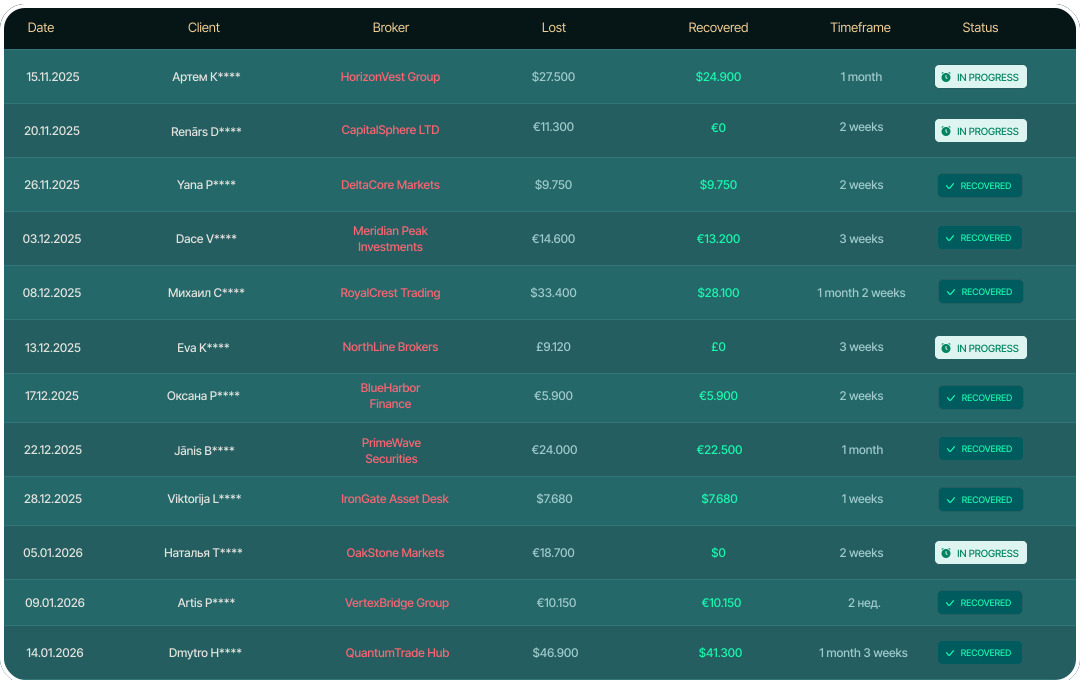
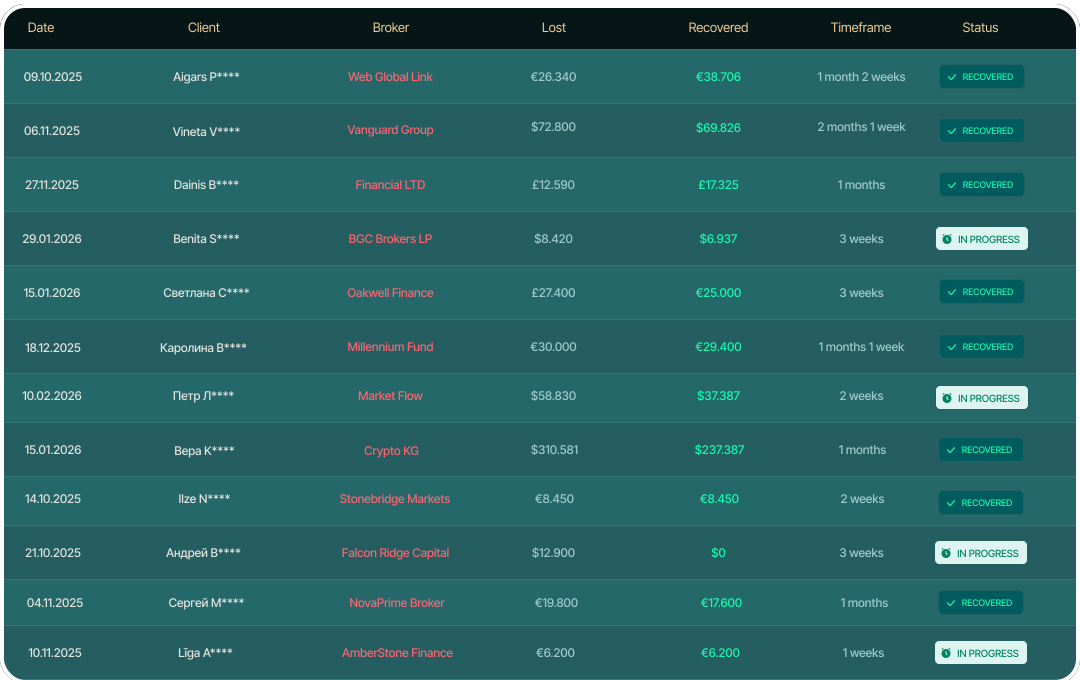

REAL-TIME UPDATES
REGISTER OF RECOVERED FUNDS
Each case involves a real client; all data is protected in accordance with the GDPR
Fund recovery cases (October 2025 - February 2026)


STAGES OF COOPERATION
A PROCESS IN WHICH YOU CONTROL EVERY STEP
RECOVERY PROCEDURE
Signing of an official legal services agreement.
Collection of evidence confirming the broker’s misconduct.
Assignment of your case to a lawyer who has already handled matters involving this specific broker.
Collection of evidence confirming the broker’s misconduct.
Assignment of your case to a lawyer who has already handled matters involving this specific broker.
RESULT
As a rule, brokers voluntarily return not only the initial deposit, but also part of the investment income, if any, since court proceedings may attract public attention.
You recover the lost funds and then pay for the lawyer’s work.
You recover the lost funds and then pay for the lawyer’s work.
DATA COLLECTION AND CASE INITIATION
Finding the final recipient of the funds you sent to the brokerage company.
Preparing documents and initiating the refund process using all possible tools and authorities.
Preparing documents and initiating the refund process using all possible tools and authorities.
FREE CONSULTATION
Submit a request, and one of our specialists will contact you shortly for a preliminary assessment of your situation.
We compare your case with similar matters already included in our working case portfolio.
We compare your case with similar matters already included in our working case portfolio.



RECOGNITION
CERTIFICATION AND GLOBAL RECOGNITION
SUBMIT A REQUEST
and our lawyers will contact you